
our communities
Kotlik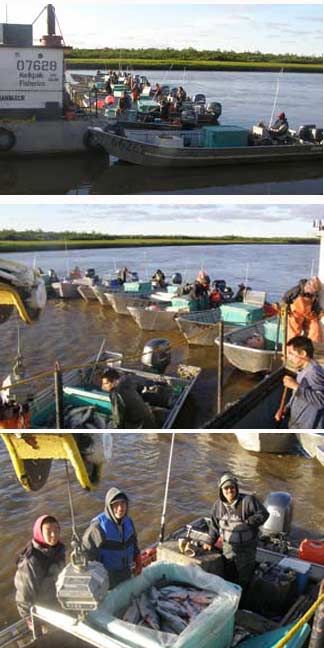
Kotlik is a Yup’ik village of 577 people practicing a seasonal fishing, trapping, and subsistence lifestyle in the Yukon-Kuskokwim Delta. Located on the east bank of the Kotlik Slough, the village is 35 miles northeast of Emmonak, 165 air miles northwest of Bethel, and 460 miles from Anchorage. Fishing and fish processing are the primary income generators. 79 residents hold commercial fishing permits, and 26 residents hold fresh water fish permits provided by Kwik’Pak Fisheries. The climate of Kotlik is subarctic; temperatures range from -50 to 87 °F. Annually, 60 inches of snow fall on average. High winds and poor visibility are common during fall and winter. Norton Sound and the Yukon are ice-free from mid-June through October.
The community grew during the mid-1960s when a Bureau of Indian Affairs school was constructed at Kotlik, and residents of the nearby villages of Channiliut, Hamilton, Bill Moore's Slough, and Pastolaik relocated. Due to its location with easy access by large riverboats and barges, Kotlik became one of the larger ports and commercial centers of the lower Yukon River. Many residents are descendants of Russian traders that settled in the area surrounding Saint Michael after 1867. The city was incorporated in 1970.
Kotlik's residents rely heavily on subsistence foods, and many families have fish camps on the Yukon River. They harvests salmon, moose, beluga whale, and seal. Some derive income from trapping. Air transportation of passengers, cargo, and mail is provided via the state-owned 4,422' long by 100' wide gravel airstrip. Kotlik has no road access, but is easily accessible by barge. Residents use the river for commercial and private travel.
Alaska Commercial Company
In 1776, Catherine the Great gave trading rights to the Russian American Company and operated trading posts throughout Alaska. When the United States bought Alaska in 1867, the company’s name was changed to the Alaska Commercial Company and was the general provider of groceries and merchandise to trappers, explorers, and gold seekers. These village posts became the center of most communities, serving as the community hall, post office, court room, marriage parlor, funeral home, and a safe haven for travelers. When the gold rush ended and the gold seekers started leaving, the number of Alaska Commercial Company stores decline rapidly. The company was sold and renamed to the Northern Commercial Company and became a major supplier for heavy equipment and machinery throughout rural Alaska. In 1977, the company was sold again to the Community Enterprise Development Corporation of Alaska (CEDC) and these eleven store branches formed the basis for the AC stores today; however, in 1992, the North West Company bought the Alaska Commercial Company and, combined, they made the largest rural retailer in North America. The Kotlik AC Store was established in 1910 and ended up being one of the larger ports after the residents from Chaniliak, Bill Moore’s Slough, Hamilton, and Pastolik moved there. A new 4,800 square foot AC store opened in Kotlik late in 2011 to better serve the community.